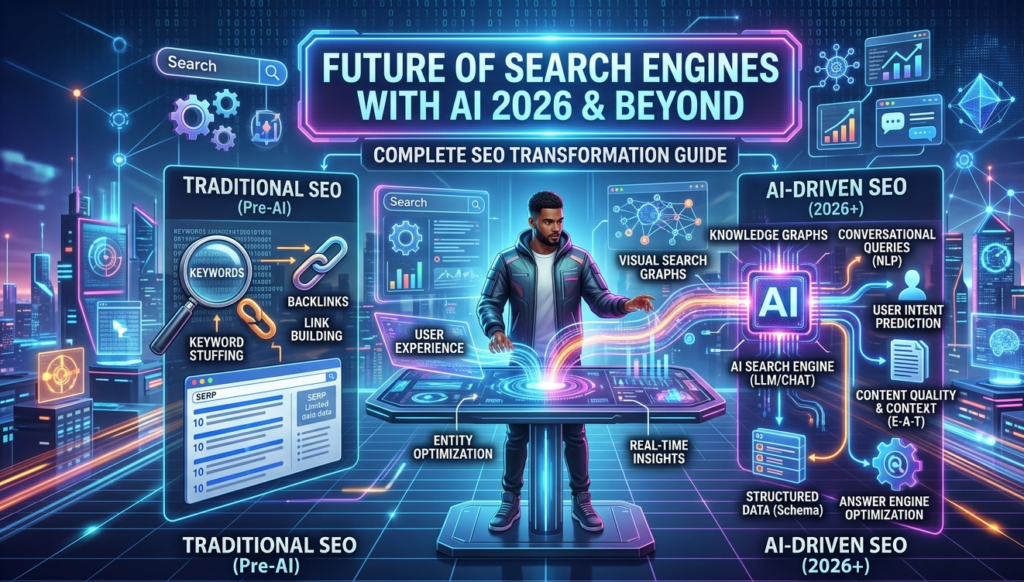
What Is the Future of Search Engines with AI?
The future of search engines with AI is centered on understanding people rather than keywords. Search engines now analyze intent, context, behavior, and preferences. As a result, users receive direct answers instead of long lists of blue links.
Google, ChatGPT Search, Gemini, and other AI-powered systems continue changing how information is discovered. Therefore, businesses must adapt quickly. Traditional SEO remains important. However, AI-driven search requires a broader strategy focused on authority, trust, and user satisfaction.
Today, ranking alone is not enough. Instead, brands must become the source that AI systems trust and reference.
How AI Is Changing Search
AI enables search engines to understand language at a human level. Previously, algorithms relied heavily on keyword matching. Today, machine learning models understand meaning and context.
For example, a user may search:
"Best AI SEO tool for beginner bloggers."
The search engine understands:
- The user is a beginner
- They need SEO software
- They want AI-powered features
- They likely have a limited budget
As a result, search becomes more accurate and useful.
AI Overviews Are Transforming SEO
AI Overviews provide summarized answers directly inside search results. Users often receive the information they need without clicking multiple websites.
This shift creates new challenges and opportunities.
Benefits
- Faster answers
- Better user experience
- Increased search satisfaction
SEO Impact
- More zero-click searches
- Greater emphasis on authority
- Increased importance of structured content
Therefore, content creators must optimize for AI-generated summaries.
From Keywords to Search Intent
Keywords still matter. However, intent matters more.
Search engines now focus on:
- Informational intent
- Commercial intent
- Transactional intent
- Navigational intent
Content should solve problems rather than target isolated keywords.
As a result, comprehensive articles perform better than thin content.
Why Entity SEO Matters
Entity SEO focuses on relationships between topics, brands, products, and concepts.
Search engines understand entities such as:
- People
- Companies
- Locations
- Technologies
- Products
When your content demonstrates expertise across related entities, AI gains greater confidence in your authority.
Consequently, your content becomes more likely to appear in AI-generated answers.
Conversational Search Is Becoming the Standard
Users increasingly interact with search engines through natural conversations.
Examples include:
- What is the best AI SEO tool?
- Which option is affordable?
- How does it compare with competitors?
Search engines now remember context between questions.
Therefore, content should answer related follow-up questions naturally.
The Rise of Predictive Search
Predictive search anticipates user needs before they complete a query.
AI analyzes:
- Search history
- User behavior
- Device usage
- Location signals
Consequently, users receive relevant recommendations sooner.
This technology creates a more personalized search experience and improves engagement.
Answer Engine Optimization (AEO)
AEO focuses on becoming the direct answer.
Instead of targeting rankings alone, content should:
- Answer questions clearly
- Use concise definitions
- Include FAQs
- Provide expert insights
AI systems often select content with direct and trustworthy answers.
Therefore, AEO has become essential for future SEO success.
Search Experience Optimization (SXO)
SXO combines SEO and user experience.
Important factors include:
- Fast loading speed
- Mobile responsiveness
- Easy navigation
- Clear formatting
- Engaging content
Search engines increasingly evaluate user satisfaction.
As a result, websites with better experiences often achieve stronger visibility.
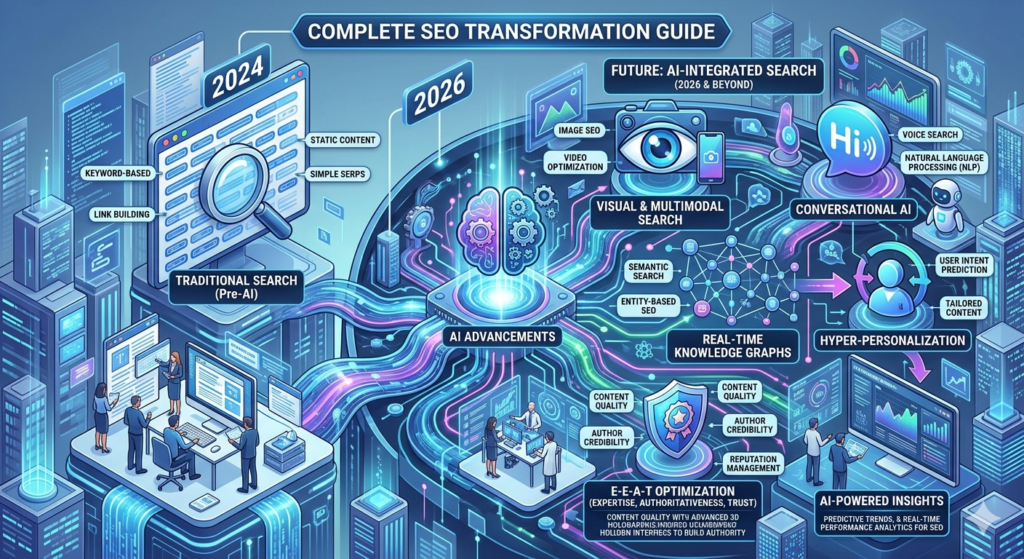
AI SEO Strategy for 2026
To succeed in AI-powered search, focus on five priorities.
1. Build Topical Authority
Create multiple articles covering related subjects.
2. Strengthen Internal Linking
Connect relevant articles naturally.
Examples:
- AI Keyword Research
- Voice Search SEO
- AI Content Optimization
3. Implement Schema Markup
Structured data helps search engines understand content.
4. Optimize for AI Overviews
Provide concise answers throughout articles.
5. Publish Predictive Content
Cover emerging topics before competitors.
Related Articles
- AI SEO strategy
- AI vs Traditional SEO: Which Strategy Wins in 2026? (Complete Guide)
- AI keyword research
Conclusion
AI is not replacing search engines. Instead, it is transforming how search works. Search engines now understand intent, context, and behavior better than ever. Consequently, SEO professionals must adapt to new ranking systems and user expectations.
The future belongs to websites that build authority, provide accurate answers, and create outstanding user experiences. Businesses that embrace AEO, entity SEO, SXO, and AI optimization today will gain a significant competitive advantage tomorrow.
Success in 2026 will not depend on ranking for keywords alone. Instead, it will depend on becoming the most trusted answer within your niche.
FAQs
Will AI replace search engines?
No. AI enhances search engines and improves result quality.
What is the future of SEO?
SEO will focus on intent, entities, authority, and user experience.
What is Answer Engine Optimization?
AEO optimizes content to become direct answers in AI search results.
How does AI improve search?
AI understands context, behavior, and intent to deliver better results.
Are AI Overviews affecting website traffic?
Yes. They increase zero-click searches while rewarding authoritative sources.
How can bloggers prepare for AI search?
Create high-quality content, build topical authority, implement schema, and optimize for AI-generated answers.
Call to Action
Ready to future-proof your website?
Explore more AI SEO strategies at:
https://seoforai2026.blogspot.com/
For advanced SEO insights, tutorials, and AI search optimization guides, visit:
https://www.seoforai.online/
Start optimizing for AI search today and position your content for Google AI Overviews, ChatGPT Search, and the next generation of intelligent search engines.