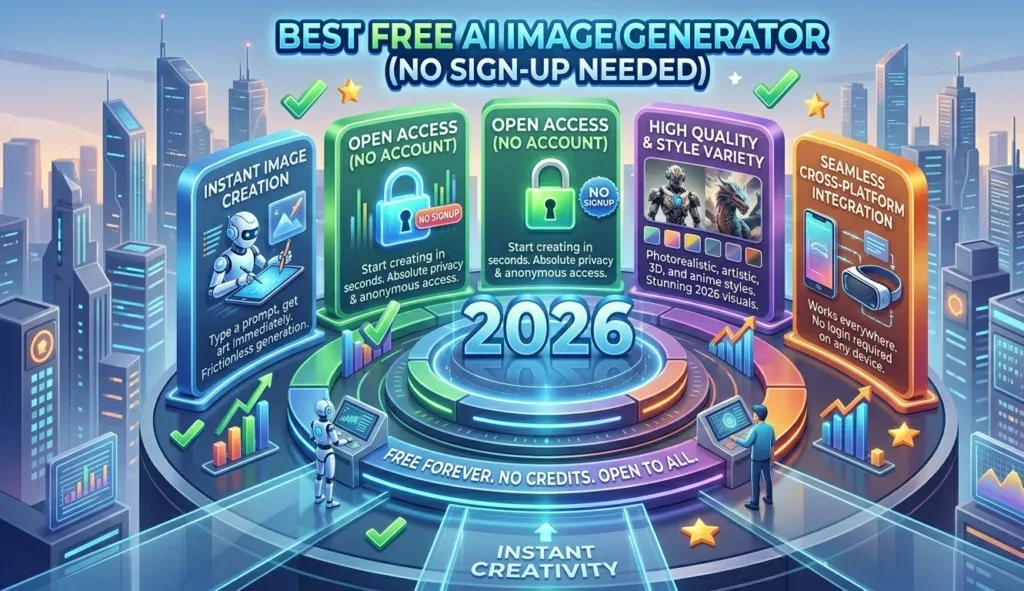
AI image generation has exploded in 2026. What used to feel like futuristic technology is now part of everyday blogging, marketing, YouTube production, eCommerce design, and even classroom projects. The surprising part? Some of the best tools are completely free. You no longer need a powerful graphics card, expensive software subscription, or professional design experience to create stunning visuals in seconds.
The challenge is separating genuinely useful tools from platforms that advertise themselves as “free” but aggressively limit features, watermark outputs, or push users into paid subscriptions after just a few generations. Many creators waste hours testing platforms that promise unlimited generation only to discover hidden restrictions halfway through a project.
This guide cuts through the noise. It covers the best free AI image generators in 2026 that actually work, produce high-quality outputs, and help creators generate visuals without complicated onboarding. The article also explains how to write better prompts, avoid copyright mistakes, and choose the right generator for your workflow. Recent testing data from multiple 2026 reviews confirms that tools like Microsoft Designer, Adobe Firefly, Ideogram, Playground AI, and Leonardo AI continue leading the market for free image generation.
Article Outline
- H1: Best AI Image Generator Free in 2026 (No Sign-Up Needed)
- H2: Why AI Image Generators Became Essential in 2026
- H3: The Rising Cost of Traditional Design
- H3: Why Bloggers and Creators Prefer AI Visuals
- H2: What Makes an AI Image Generator Truly Free
- H3: Hidden Limits Most Platforms Don’t Mention
- H3: Commercial Licensing and Usage Rights
- H2: Best Free AI Image Generators in 2026
- H3: Adobe Firefly — Best for Commercial Safety
- H3: Microsoft Designer — Best for Beginners
- H3: Canva AI Image Generator — Best Workflow Integration
- H3: Ideogram — Best for Text Inside Images
- H3: Playground AI — Best for Artistic Styles
- H3: Leonardo AI — Best Overall Free Tier
- H2: Comparing the Top Free AI Image Generators
- H3: Feature Comparison Table
- H2: How to Write Better AI Image Prompts
- H3: Weak Prompt vs Strong Prompt
- H3: Prompt Elements That Improve Image Quality
- H2: AI Image Copyright Rules in 2026
- H3: Commercial Use Explained
- H3: Why Human Editing Still Matters
- H2: Tips for Bloggers Using AI Images
- H3: SEO Benefits of Custom AI Images
- H3: How AI Visuals Improve Engagement
- H2: Conclusion
- H2: FAQs
- H2: Why AI Image Generators Became Essential in 2026
Why AI Image Generators Became Essential in 2026
The internet runs on visuals now. Open any successful blog, YouTube channel, ecommerce store, or Instagram page and you’ll notice something immediately: every piece of content is heavily visual. Readers expect polished featured images, thumbnails, infographics, social banners, and branded graphics everywhere they go. The problem is that traditional graphic design remains expensive and time-consuming for most creators. Hiring a designer for every blog post simply doesn’t make financial sense for small publishers or solo creators.
That’s exactly why AI image generators exploded in popularity. Instead of spending hours editing stock photography or learning Photoshop from scratch, creators can now type a sentence and generate custom visuals instantly. It feels almost like having a digital artist available 24/7. A travel blogger can create cinematic mountain photography without leaving home. A food blogger can generate elegant restaurant-style images for recipe posts. A tech creator can build futuristic concept art for tutorials in less than a minute.
Recent testing across multiple industry reviews shows that free AI image tools have improved dramatically in realism, prompt understanding, and typography rendering during 2026. Some free outputs are now visually competitive with premium platforms that cost $20 to $40 monthly just two years ago. That’s a massive shift in the creative landscape.
For bloggers especially, AI image generators solve several painful problems at once:
- Expensive stock photo subscriptions
- Generic visuals used by thousands of websites
- Time-consuming editing workflows
- Inconsistent branding across posts
- Lack of design experience
Instead of searching endlessly through stock libraries, creators now generate visuals tailored exactly to their content. It’s the difference between renting a generic apartment and designing your own custom home.
What Makes an AI Image Generator Truly Free
A lot of AI platforms use the word “free” very loosely. Some tools give you three images and then immediately ask for a credit card. Others slap giant watermarks over every output unless you upgrade. A few even limit image quality so heavily that the results become unusable for professional content.
A truly free AI image generator should provide enough daily or monthly generations to create meaningful work without forcing users into paid plans immediately. It should also produce outputs that are clean enough for blogs, thumbnails, social media, and marketing materials. Most importantly, it should clearly explain commercial usage rights instead of hiding restrictions deep inside legal documents.
One of the biggest frustrations creators face in 2026 is discovering copyright or licensing limitations after already publishing AI-generated content. That’s why commercial safety matters more than ever. Adobe Firefly stands out because its model was trained primarily on licensed Adobe Stock content and public-domain materials. This dramatically reduces concerns around copyright disputes compared to some models trained on scraped internet data.
Another thing users often overlook is workflow efficiency. A platform may generate beautiful images, but if exporting, editing, resizing, and organizing those images becomes frustrating, productivity suffers. Canva AI succeeds largely because creators can generate and design within the same environment. Microsoft Designer excels because it minimizes setup friction entirely. Ideogram dominates text rendering because many generators still struggle to spell words correctly inside images.
The reality is simple: the best AI image generator isn’t necessarily the one producing the prettiest image. It’s the one that fits naturally into your content workflow without slowing you down.
Adobe Firefly — Best Free AI Image Generator for Commercial Safety
Adobe continues positioning Firefly as the safest AI image generator for businesses, marketers, and professional creators concerned about copyright risks. In a world where AI-generated content still faces legal uncertainty, Firefly’s training approach gives it a major competitive advantage.
Unlike many competing generators trained on scraped online artwork, Firefly relies heavily on licensed Adobe Stock images and public-domain material. That means bloggers, agencies, and businesses feel more comfortable using generated visuals commercially. For monetized blogs, sponsored posts, client projects, and marketing campaigns, that peace of mind matters enormously.
The free plan currently includes around 25 monthly generative credits according to recent 2026 testing. While that limit is lower than some competitors, the image quality and professional integration compensate for the restriction. Firefly also integrates directly into Adobe Express and other Adobe ecosystem products, creating a seamless editing workflow.
What really makes Firefly shine is precision. The prompts tend to follow instructions closely, especially for professional-style imagery. If you request “minimalist workspace photography with warm natural light and Scandinavian furniture,” Firefly usually understands the assignment remarkably well.
Creators also appreciate its editing capabilities:
| Feature | Available in Free Plan |
|---|---|
| Text-to-image generation | Yes |
| Generative fill | Yes |
| Commercial-safe outputs | Yes |
| Watermark-free exports | Yes |
| Adobe Express integration | Yes |
For businesses and bloggers earning revenue, Firefly is arguably the safest long-term option among free AI image tools.
Microsoft Designer — Best Free AI Image Generator for Beginners
Microsoft Designer remains one of the easiest and most beginner-friendly AI image generators available in 2026. Powered by DALL·E technology, it delivers surprisingly high-quality visuals with minimal effort. You don’t need prompt engineering expertise, design knowledge, or advanced settings to create professional-looking images.
That simplicity is exactly why beginners love it. You type a natural sentence like:
“A futuristic cyberpunk coffee shop during rain at night”
…and within seconds, Microsoft Designer generates multiple polished variations ready for thumbnails, blog posts, or social graphics.
Recent reviews confirm Microsoft Designer still offers daily boosted generations with slower generation continuing afterward instead of completely blocking free users. That makes it one of the few genuinely usable free platforms for casual creators.
Its strengths include:
- Extremely easy interface
- Strong prompt understanding
- Fast generation speed
- Integrated Microsoft ecosystem
- Excellent photorealism
The platform works especially well for:
- Blog featured images
- YouTube thumbnails
- Pinterest graphics
- Simple product mockups
- Social media content
There’s also a psychological advantage here. Complex creative software often intimidates beginners. Microsoft Designer feels approachable. It behaves more like chatting with an assistant than operating complicated design software.
The downside is limited creative control compared to advanced platforms like Stable Diffusion or Leonardo AI. But for most creators, simplicity beats technical complexity every single time.
Canva AI Image Generator — Best for Workflow Integration
Canva understood something many AI companies missed: creators don’t just want image generation. They want streamlined workflows.
That’s why Canva’s AI image generator remains one of the smartest integrations in the market. Instead of generating an image in one app and editing it elsewhere, Canva allows users to create, edit, resize, and publish visuals inside a single environment.
For bloggers and social media creators, this saves enormous time.
Imagine generating a blog thumbnail, adding text overlays, resizing it for Pinterest, and exporting a social banner without ever switching tabs. That convenience feels small until you repeat the process dozens of times every week.
Canva’s Magic Media feature supports multiple styles, including:
- Photorealistic visuals
- Illustrations
- Flat graphics
- Anime-inspired artwork
- Concept designs
The free plan includes limited AI credits that refresh monthly. While not unlimited, the workflow efficiency often outweighs the generation limits.
Canva particularly excels for creators producing:
- Instagram carousels
- Blog banners
- Infographics
- Pinterest pins
- Presentation graphics
One reason Canva remains dominant is accessibility. It removes friction. You don’t need to understand layers, masks, advanced rendering settings, or professional editing terminology. Everything feels intuitive, almost like dragging Lego blocks into place.
For non-designers, that simplicity is priceless.
Ideogram — Best Free AI Generator for Text Inside Images
Ideogram solved one of AI image generation’s biggest problems: readable text.
Most AI image tools still struggle terribly when generating typography. Ask many generators to create a poster saying “Summer Sale,” and you’ll get something resembling alien hieroglyphics instead. Ideogram changed that.
Recent 2026 testing consistently ranks Ideogram among the strongest platforms for text-heavy visuals. That makes it incredibly valuable for YouTube thumbnails, social ads, blog headers, posters, and branding graphics.
Creators love it because text accuracy directly impacts engagement. A thumbnail with readable words performs dramatically better than one with distorted lettering.
Ideogram’s free tier typically includes daily generations with slower queues available afterward. The quality is excellent for both photorealistic scenes and stylized designs.
It performs especially well for:
- YouTube thumbnails
- Posters
- Typography designs
- Pinterest graphics
- Marketing banners
The platform also handles layout composition surprisingly well. Instead of awkwardly placing text randomly, Ideogram often creates balanced, visually pleasing arrangements automatically.
That’s important because good design isn’t just about image quality. It’s about hierarchy, readability, and composition working together harmoniously.
Playground AI — Best for Creative and Artistic Images
Playground AI appeals strongly to creators who value artistic flexibility over rigid realism. If Microsoft Designer feels like a practical sedan, Playground AI feels like a customizable sports car with neon underglow.
The platform offers extensive style experimentation. Users can generate:
- Anime artwork
- Oil painting aesthetics
- Cinematic photography
- Fantasy illustrations
- Surreal concept art
- Digital paintings
That variety makes Playground AI popular among lifestyle bloggers, gaming creators, artists, and social media marketers.
One major advantage is generation volume. Several 2026 reviews note generous free generation limits compared to more restrictive competitors. For creators producing large amounts of content daily, those higher caps matter significantly.
Playground AI also encourages experimentation. Instead of rigidly optimizing productivity, it invites users to play creatively. That freedom often leads to unexpectedly unique visuals that stand out from generic stock imagery flooding the internet.
There’s something refreshing about that.
Not every image needs corporate polish. Sometimes creators want weird, expressive, imaginative visuals that feel handcrafted rather than algorithmically sterile.
Playground AI thrives in that creative space.
Leonardo AI — Best Overall Free Tier
Leonardo AI is frequently ranked among the strongest overall free AI image generators in 2026. Multiple recent reviews highlight its generous token system, advanced editing capabilities, and access to high-quality image models.
What makes Leonardo especially attractive is balance. It combines:
- Strong image quality
- Generous free limits
- Commercial usability
- Editing tools
- Style customization
Many creators describe Leonardo as the sweet spot between beginner accessibility and professional-level control.
Its editing features are particularly impressive for a free platform:
| Leonardo AI Features | Included |
|---|---|
| Image-to-image editing | Yes |
| Inpainting | Yes |
| Outpainting | Yes |
| Style presets | Yes |
| Multiple AI models | Yes |
| Daily free tokens | Yes |
Leonardo performs exceptionally well for:
- Game assets
- Concept art
- Character design
- Product visualization
- Creative branding
For creators who want more artistic control without diving fully into technical Stable Diffusion workflows, Leonardo feels like an ideal middle ground.
How to Write Better AI Image Prompts
The difference between an average AI image and an incredible one usually comes down to prompting. Think of prompts like giving directions to a photographer. If your instructions are vague, the results become unpredictable.
A weak prompt looks like this:
“Woman using laptop”
That gives the AI almost nothing to work with.
A stronger prompt might say:
“Young professional woman working on a silver laptop at a modern wooden desk, warm morning sunlight through large windows, shallow depth of field, minimalist Scandinavian office, realistic photography style, ultra-detailed, 4K”
Notice how much more specific that feels? You’re not just describing a subject anymore. You’re describing mood, lighting, composition, environment, and visual style simultaneously.
The best prompts usually include:
- Subject
- Environment
- Lighting
- Camera angle
- Mood
- Art style
- Resolution quality
- Color palette
Prompt engineering sounds technical, but it’s really storytelling. You’re painting a mental picture using words.
One surprisingly effective trick is referencing photography terminology:
- “Golden hour lighting”
- “Shallow depth of field”
- “Editorial photography”
- “Wide-angle cinematic shot”
AI models respond remarkably well to those cues because much of their training data includes photography descriptions.
AI Image Copyright Rules in 2026
Copyright law surrounding AI images remains complicated in 2026. Governments and legal systems worldwide are still adapting to rapidly evolving generative AI technology.
The biggest issue is authorship.
The U.S. Copyright Office has clarified that purely AI-generated images without meaningful human contribution may not qualify for traditional copyright protection. That means creators should still modify, edit, brand, or customize generated visuals whenever possible.
This is another reason platforms like Adobe Firefly attract professionals. Their commercially safer training practices reduce legal uncertainty significantly.
For bloggers and marketers, the safest approach includes:
- Adding branding elements
- Editing AI outputs manually
- Combining multiple generated assets
- Using custom overlays and typography
- Verifying platform commercial licenses
Human creativity still matters enormously. AI works best as a creative partner rather than a complete replacement for artistic decision-making.
Think of AI like a powerful camera. Owning the camera doesn’t automatically make someone a great photographer. Human direction still shapes the final result.
Tips for Bloggers Using AI Images
Custom visuals dramatically improve content performance online. Readers engage longer with articles that include unique imagery instead of generic stock photos repeated across hundreds of websites.
AI-generated images also provide SEO advantages when optimized correctly.
Best practices include:
| SEO Element | Recommendation |
|---|---|
| File names | Use descriptive keywords |
| Alt text | Describe image naturally |
| Compression | Optimize loading speed |
| Image relevance | Match article intent |
| Unique visuals | Avoid duplicate stock imagery |
Google increasingly rewards content experiences that feel original and useful. AI-generated visuals help smaller creators compete visually with larger publications.
There’s also branding consistency to consider. AI tools allow bloggers to maintain consistent visual styles across every article. Instead of random stock photos with clashing aesthetics, creators can establish recognizable visual identities.
That consistency builds trust.
Readers subconsciously associate polished visuals with authority and professionalism. Even if your written content is outstanding, weak visuals can reduce perceived credibility instantly.
Conclusion
The best free AI image generator in 2026 depends entirely on your workflow and creative goals.
If commercial safety matters most, Adobe Firefly remains the strongest choice. If you want simplicity and speed, Microsoft Designer delivers excellent results with minimal effort. Canva AI dominates integrated design workflows, while Ideogram excels at text-heavy visuals. Playground AI offers artistic flexibility, and Leonardo AI provides arguably the most balanced free experience overall.
The biggest takeaway is this: creators no longer need expensive design software or professional artistic skills to produce stunning visuals. AI image generation has become accessible, fast, and genuinely practical for everyday content creation.
The gap between free and premium image generation tools has narrowed dramatically in 2026. That’s incredibly exciting for bloggers, entrepreneurs, students, marketers, and creators everywhere.
The future of visual content creation is no longer limited by budget. It’s limited only by imagination.
FAQs
Q1. Can I use free AI-generated images on a monetized blog?
Yes, but always check the platform’s commercial usage policy first. Adobe Firefly is considered one of the safest options for commercial projects because of its licensed training data.
Q2. Which free AI image generator is best for beginners?
Microsoft Designer is widely considered the easiest tool for beginners because of its simple interface and strong prompt understanding.
Q3. Which AI image tool creates the best text inside images?
Ideogram currently leads in accurate typography rendering for thumbnails, posters, and social graphics.
Q4. Are free AI image generators improving every year?
Absolutely. Recent 2026 reviews show major improvements in realism, prompt accuracy, text rendering, and editing tools compared to earlier generations.
Q5. Do AI-generated images help SEO?
Yes. Unique visuals can improve engagement, reduce bounce rates, increase shareability, and strengthen topical relevance when optimized correctly with alt text and descriptive filenames.