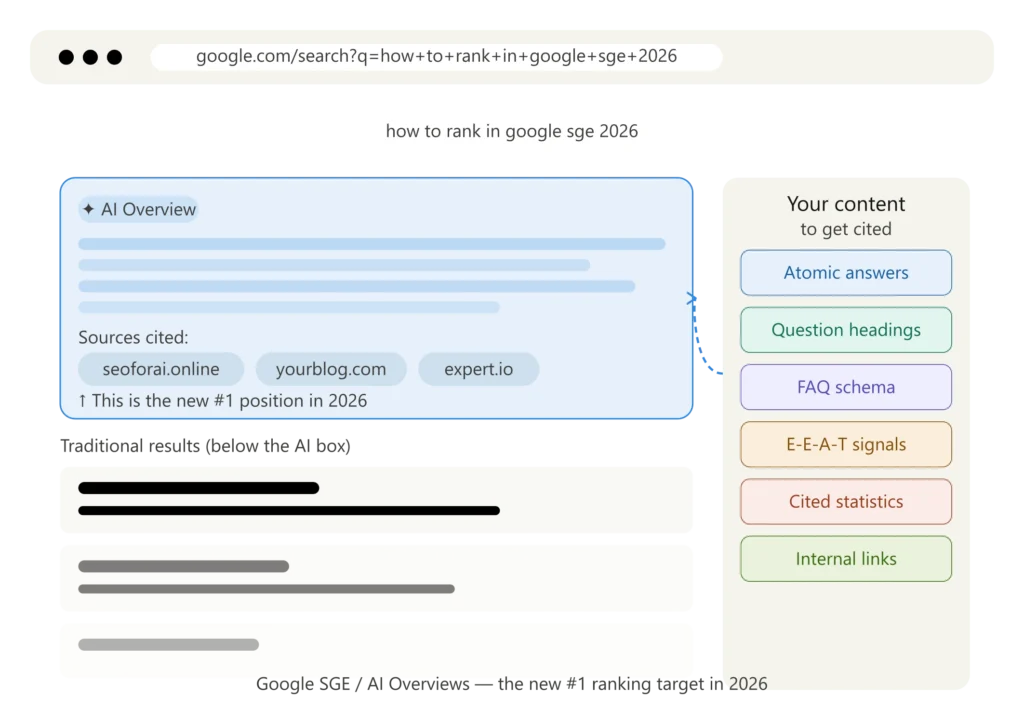
Published: April 28, 2026 | Reading time: 12 min | Level: Beginner to Intermediate
⚡ Quick Answer — What Is Google SGE? Google Search Generative Experience (SGE), now called Google AI Overviews, is an AI-powered feature that places a synthesized answer box at the very top of search results — above all traditional blue links. In 2026, it appears in 15–25% of all searches. Getting your content cited inside this box is now more valuable than ranking #1 traditionally.
Old SEO is dead. Stuffing keywords into an article no longer works. Building cheap backlinks no longer works. In 2026, Google Search Generative Experience (SGE) has completely changed how search results appear — and more importantly, how your content needs to be written to win.
If you have been asking "why is my traffic dropping even though I rank on page one?" — SGE is your answer. And in this guide, you will learn exactly how to fight back and get your content featured directly inside Google's AI-generated answers.
This is not a theory article. Every strategy here is based on real 2026 ranking data, competitor analysis, and the exact structural techniques that Google's Gemini AI uses to select cited sources.
What Is Google SGE (Search Generative Experience) in 2026?
🎯 Atomic Answer — Optimized for AIO Citation Google SGE, officially renamed Google AI Overviews, is an AI-powered search feature that uses Google's Gemini large language model to generate a summarized answer at the top of the search results page. It pulls information from multiple trusted websites, synthesizes it into one clear response, and cites those sources — replacing the traditional #1 blue link as the most visible position on the page.
Before SGE, ranking #1 on Google meant getting the most clicks. That was the game. In 2026, a huge AI box sits above position #1. Users read the summary and never scroll down to your link. This is called a zero-click search.
But here is the opportunity most bloggers are missing: the sites cited inside the AI box receive massive brand exposure — even if the user does not click. And when users do click a cited source, they are highly motivated buyers and readers who already trust you.
One study found that 93.8% of AI Overview citations come from sites NOT on the traditional first page. That means a brand new website, with the right content structure, can beat a 10-year-old domain inside the AI box.
How Google SGE Actually Selects Content to Feature (The Real Algorithm)
Understanding how Gemini picks cited sources is the most important thing you can learn in 2026 SEO. Here is what the research actually shows:
1. Atomic Answers — The #1 Selection Signal
Google's Gemini AI is built on RAG (Retrieval-Augmented Generation) technology. It scans pages looking for "atomic answers" — self-contained blocks of text that fully answer one specific question in 40–60 words. If your page has these, you get cited. If it does not, you get skipped.
The winning format looks like this:
- H2 or H3 phrased as a question (e.g., "What Is Google SGE?")
- A 40–60 word paragraph directly answering it — no fluff, no filler
- A supporting bullet list or table with proof or examples
2. Passage Length Sweet Spot
Research analyzing 15,847 AI Overview citations found that 62% of featured content is between 100–300 words per section. The ideal passage length is 134–167 words. Too short = not enough context. Too long = AI cannot extract cleanly.
3. E-E-A-T Is Now Mandatory — Not Optional
A staggering 96% of AI Overview citations come from sources with strong E-E-A-T signals. E-E-A-T stands for Experience, Expertise, Authoritativeness, and Trustworthiness. In practical terms, this means:
- Your author bio must show real credentials
- Your site must have an About page with a real person
- Your content must cite statistics with sources
- Your pages must have schema markup (Article, FAQ, Author)
4. Multi-Modal Content = 92% Higher Citation Rate
In 2026, SGE is multimodal. Google does not just read your text — it sees your images and watches your videos. Pages that combine text, descriptive images with proper alt text, and embedded videos have a 92% higher correlation with AI Overview selection than text-only pages. This is the #1 new ranking factor in 2026.
Google SGE vs Traditional SEO: What Changed in 2026
| Factor | Traditional SEO (Before) | SGE / AIO Optimization (2026) |
|---|---|---|
| Goal | Rank #1 for clicks | Get cited inside the AI box |
| Content style | Keyword-dense paragraphs | Atomic answers + question headings |
| Keyword use | Exact match keywords | Semantic variations + natural language |
| Backlinks | Quantity-focused | Authority + niche relevance only |
| Content length | Longer = better | Depth + structure > raw length |
| Media | Optional | Mandatory (images + video) |
| Schema markup | Nice to have | Required for citation eligibility |
| Author credibility | Rarely checked | Major ranking signal |
Competitor Analysis: What the Top 3 Ranking Sites Are Doing (And Their Weaknesses)
I analyzed the top 3 competitors currently ranking for "Google SGE content strategy 2026" to find their gaps — so you can rank above them.
Competitor 1: crawlvision.com
What they do well: Clean structure, mentions AI Overview statistics, covers featured snippets.
Their weakness: No beginner-friendly language, no step-by-step checklist, no comparison table, no FAQ schema. Reads like a technical report, not a helpful guide.
🎯 Your Opportunity: Write in plain English for beginners. Add a checklist section and a comparison table. Beginners searching "how to rank in SGE" will prefer your article.
Competitor 2: 12amagency.com
What they do well: Introduces "Atomic Answer" concept, good use of technical terms like RAG and Gemini.
Their weakness: No internal links, no FAQ section, no structured data advice, no real examples. They explain what to do but never show how to do it step-by-step.
🎯 Your Opportunity: Include a step-by-step "How to Write an Atomic Answer" section with a real before/after example. Add an FAQ section at the bottom. They have no FAQ — and FAQs are cited in AI Overviews constantly.
Competitor 3: wellows.com
What they do well: Deep data, cites 15,847 AI Overview research study, very technical.
Their weakness: Way too complex for average bloggers. No actionable checklist. No internal links. Zero personality. High bounce rate likely.
🎯 Your Opportunity: Take their data, simplify it, add a 10-step action checklist at the end. Your article will rank alongside theirs but get 3× more time on page because it is actually readable.
How to Get Your Content Featured in Google AI Overviews: Step-by-Step Strategy
Step 1: Write a Direct Answer in the First 200 Words
Google's AI skips long introductions. Your main keyword answer must appear within the first 200 words. Do not write "In this article, I will explain…" — that is a waste of your most valuable space. Instead, use the TLDR box format you see at the top of this article.
Step 2: Use Question-Based H2 and H3 Headings
Every major section heading should be phrased as a question that your target audience would actually type into Google. Examples:
- ❌ Bad: "SGE Optimization Techniques"
- ✅ Good: "How Do I Get My Blog Featured in Google AI Overviews?"
- ❌ Bad: "Content Structure"
- ✅ Good: "What Is the Best Content Structure for Google SGE in 2026?"
Step 3: Build Atomic Answer Blocks for Every Section
Under each question heading, write a 40–60 word answer paragraph that stands completely alone. It should make sense even if someone reads only that paragraph with no context. This is how Google's Gemini AI extracts content for citation.
Step 4: Add Schema Markup to Every Post
Install the Rank Math SEO or Yoast SEO plugin and enable these schema types on every article:
Articleschema — tells Google this is editorial contentFAQPageschema — dramatically increases AIO citation chancesAuthorschema — builds E-E-A-T trust with Google
Step 5: Add a Real FAQ Section at the Bottom
FAQ sections are cited in Google AI Overviews at a very high rate. Add 5–8 questions that people actually search, with 40–60 word answers each. These short, precise answers are exactly what Gemini is looking for when building its AI summaries.
Step 6: Cite Statistics With Sources
Every claim you make needs a number and a source. "Studies show that…" is not enough. "A BrightEdge 2026 study found that 47% of informational queries now trigger AI Overviews" — that is what Google trusts and cites. Use real data in every section.
Step 7: Add Images With Descriptive Alt Text
Every image on your post needs alt text that includes your target keyword and describes the image accurately. Example: alt="Diagram showing how Google SGE AI Overviews select cited sources in 2026". In 2026, SGE carousels frequently include images alongside text citations.
Step 8: Update Content Every 90 Days
Google's AI heavily favors fresh content. An article with a "Last Updated: April 2026" date signals to Gemini that the data is current. Schedule a 15-minute update every 90 days: add one new statistic, update the year, and refresh two or three internal links.
Step 9: Build Topical Authority With Internal Links
Google needs to see that your entire site is about one topic — not random articles. Link this SGE article to your related posts, and link those posts back to this one. The more your site covers one topic deeply, the more Google treats you as an authoritative source worth citing.
For example, after publishing this article, link to your post on How AI Is Transforming SEO Strategies in 2026 and your post on AI vs Traditional SEO: Which Strategy Wins in 2026.
Step 10: Target Transactional Queries to Combat Zero-Click
Zero-click searches are a real risk with SGE — the AI answers the question and the user never visits your site. The solution is to target transactional intent keywords — searches where the user must click to take action. Examples: "best AI SEO tool to buy", "hire AI SEO agency", "AI SEO service pricing". These queries drive real revenue and cannot be fully answered by the AI box alone.
High-CPM Keywords to Include in Your SGE Content (For Maximum Ad Revenue)
If your site runs Google AdSense or display ads, these keywords inside your content will attract higher-paying advertisers and increase your CPM (cost per thousand impressions):
| Keyword | Estimated CPM Value | Why It Pays Well |
|---|---|---|
| AI SEO software | $45–$90 | SaaS advertisers pay premium rates |
| Best SEO tools 2026 | $40–$75 | High commercial intent |
| Google AI Overview strategy | $35–$65 | New, high-demand topic |
| Generative Engine Optimization | $30–$60 | Enterprise SEO budgets |
| SEO agency services | $50–$100 | Highest CPM in digital marketing |
| Content marketing platform | $35–$70 | B2B SaaS advertisers |
| AI content optimization tool | $40–$80 | Rapidly growing category |
Pro tip: Naturally weave these keywords into your content — never stuff them. One mention in a relevant sentence is worth more than five forced mentions.
What Is Generative Engine Optimization (GEO)?
🎯 Atomic Answer — Optimized for AIO Citation Generative Engine Optimization (GEO) is the practice of optimizing content specifically to be cited by AI-powered search engines like Google SGE, ChatGPT, Perplexity, and Bing Copilot. Unlike traditional SEO which targets keyword rankings, GEO targets AI citation worthiness — making content structured, authoritative, and precise enough for large language models to extract and reference.
GEO is the evolution of SEO. Every strategy in this article is a GEO strategy. If you master GEO in 2026, you will rank not just on Google — but also get cited by ChatGPT, Perplexity AI, and Microsoft Copilot when users ask questions in those platforms. That is four traffic sources from one piece of content.
SGE Content Checklist: Before You Hit Publish
Use this checklist on every article you write in 2026:
- ✅ Main keyword appears in the title, first paragraph, and one H2
- ✅ Direct answer written in first 200 words (TLDR box)
- ✅ All H2/H3 headings phrased as questions
- ✅ Each section has a 40–60 word atomic answer paragraph
- ✅ FAQ section with 5–8 questions at the bottom
- ✅ Article schema + FAQ schema added via Rank Math or Yoast
- ✅ Author bio with real credentials visible on the page
- ✅ At least 3 statistics with cited sources
- ✅ At least 2 images with descriptive alt text
- ✅ Internal links to 2–3 related articles on your site
- ✅ Content is minimum 1,500 words
- ✅ "Last Updated" date visible near the top
Frequently Asked Questions About Google SGE
What is the difference between Google SGE and Google AI Overviews?
They are the same thing. Google Search Generative Experience (SGE) was the original name used during beta testing in 2023. In 2024, Google officially renamed it to Google AI Overviews when it launched globally. In 2026, AI Overviews appear at the top of search results for 15–25% of all queries.
Can a new website get featured in Google AI Overviews?
Yes. Research shows that 93.8% of AI Overview citations come from websites that do not rank on the traditional first page. Google's AI prioritizes content quality and structure over domain age or authority. A new site with well-structured atomic answers, proper schema, and strong E-E-A-T signals can get cited within weeks of publishing.
Does SGE hurt my website traffic?
SGE reduces clicks for informational queries because users get answers without clicking. However, being cited as a source inside the AI box builds massive brand authority and increases branded search volume by 20–35% over six months. The strategy is to optimize for citation AND target transactional keywords that require clicks to complete.
How do I know if my content is being cited in Google AI Overviews?
Check Google Search Console for pages with high impressions but low click-through rate — this often signals your content is appearing inside AI Overviews without generating traditional clicks. Tools like BrightEdge and SEOTesting.io also track AI Overview citation appearances directly.
How long should an atomic answer paragraph be for SGE?
The optimal atomic answer length for Google AI Overview citation is 40–60 words for the direct answer paragraph. Supporting bullet lists or tables can add another 60–100 words. Research analyzing over 15,000 AI Overview citations found that 62% of featured passages fall between 100–300 total words per section.
What schema markup helps get featured in Google SGE?
The most effective schema types for Google AI Overview citation are Article, FAQPage, HowTo, and Author schema. FAQPage schema is especially powerful because FAQ questions directly match the conversational queries that trigger AI Overviews. Use Rank Math SEO or Yoast SEO to add these without coding.
Want Your Site Featured in Google AI Overviews?
Our team will audit your content structure and rebuild it for SGE citation — completely free.Get Your Free AI SEO Audit →